I’m not sure what’s going to happen to us because of Artificial Intelligence (AI), but it won’t be good. The only people who are excited about AI are the grotesquely wealthy people who will become even more grotesque with wealth as they let it take over the world.
Until the end of all life as we know, I’ve been tinkering with AI – not too much, but just enough to have a bit of fun. Below is the result; the musings of a middle-age man with an adolescent sense of self-amusement. (In fact, most men never outgrow their teenage impulses. Perhaps, that’s more dangerous than the global destruction to be visited upon us by AI, but I doubt it.)
I thought it was amusing to create a long-lost novel by some prissy writer whose work I’ve never read but only imagined what it would be.
Here then is A Splendid Air of Gentlemanly Flatulence.
In A Splendid Air of Gentlemanly Flatulence, Jane Austen casts her discerning eye on the subtler trials of courtship among the well-heeled. Lady Honoria Featheringstone, a genteel young woman with a fondness for butterflies and botanical sketching, finds herself courted by the Honourable Archibald Fitzwilliam-Smythe, a man o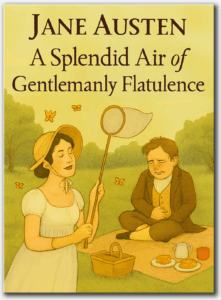 f sterling lineage and tragically turbulent digestion.
Set over a summer of increasingly strained picnics in Cambridge’s lesser-known parks, the novel follows Mr. Fitzwilliam-Smythe’s gallant efforts to suppress his persistent flatulence beneath layers of etiquette, lying, and quiet desperation.
Austen’s signature wit is on full display as she skewers the rituals of polite society, revealing that love, like digestion, is rarely without complication. Enjoy a tale of restraint, release, and the quiet triumph of empathy over decorum during episodes of a “gentleman’s thunder.”
The narrative’s whimsy is best captured in a correspondence from Lady Featheringstone to her elder sister, “If we are to be remembered for Mr. Fitzwilliam-Smythe’s bodily breezes, let it be said that they carried us forward.”